
30 July 2026 · 5 min read
How It Works: From Order to Payment
A plain-English walkthrough of what happens from order to payment on Artega: verification, stablecoin conversion, and what's visible on-chain vs. never collected.
How It Works: From Order to Payment
A plain-English guide to what happens when you order and pay through Artega, whether you're the client or the practitioner receiving it.
The short version
Artega is a set of tools: an offerings page, an ordering flow, and a way to record payment. It isn't the payment platform itself. That job belongs to Wert, a regulated payment partner, who handles verification and the movement of money. Artega never holds funds at any point.
Here's what actually happens:
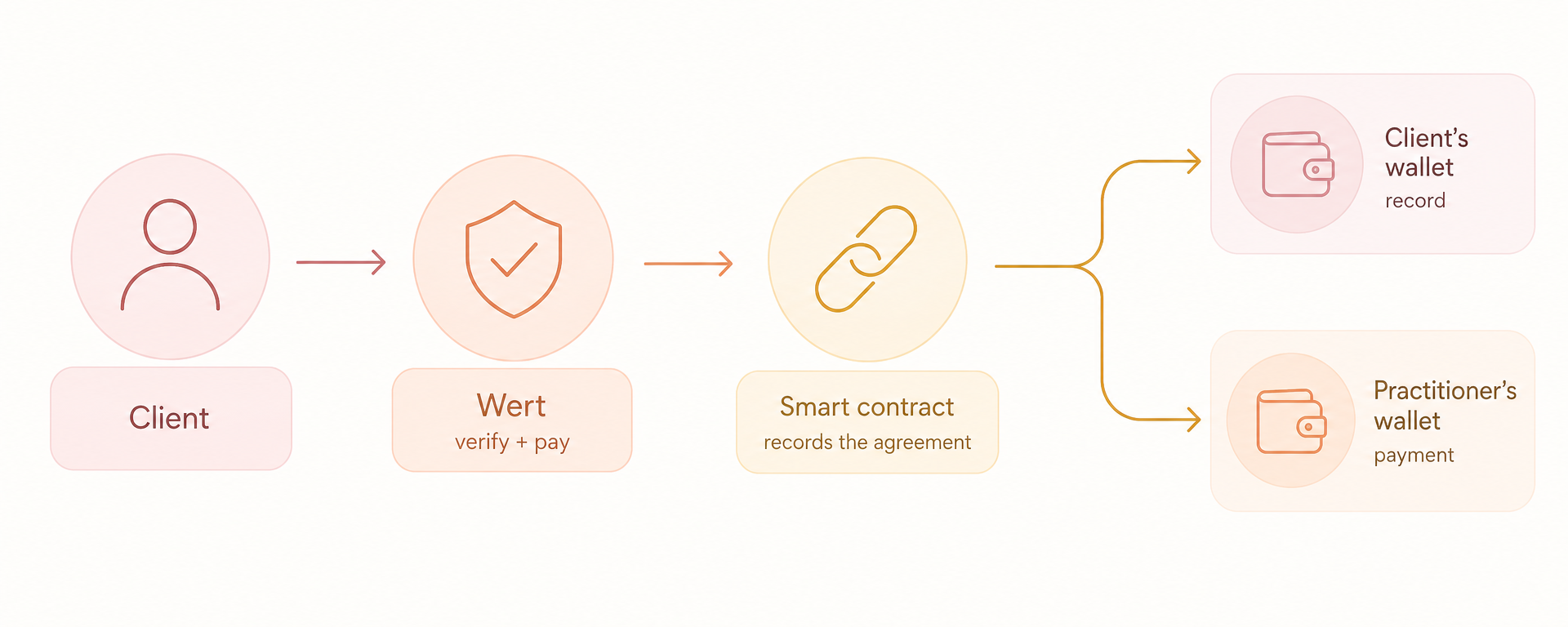
- The client verifies who they are with Wert, our payment partner. Standard practice, the same as opening a bank account.
- Wert converts the payment into a stablecoin, a type of cryptocurrency pegged to a normal currency so its value doesn't move around.
- A smart contract, a small piece of automated code on the blockchain, generates a proof of agreement (NFT) between client and practitioner and sends payment on to the practitioner. The client's copy of that record lives in a wallet.
Step by step
- The client chooses an offering on the Artega platform.
- Basic details are collected to set up the order.
- The client connects a wallet, or one is generated for them. A wallet is a secure digital address that holds records like this one, think of it as a delivery address that lives on the blockchain instead of the postal system.
- The client is handed over to Wert to complete the transaction.
- Wert verifies the client's identity (see below for why) and takes payment.
- Wert converts the payment into the stablecoin needed to settle on-chain.
- A smart contract receives the funds, generates the proof-of-agreement (NFT) record, sends it to the client's wallet, and forwards the payment to the practitioner's wallet.
- Both parties get confirmation that the order is complete.
Artega records that the agreement happened. It doesn't guarantee the order, mediate disputes between client and practitioner, or stand behind delivery the way a marketplace might.
Why does the client need to verify identity?
This step is run by Wert, not by Artega.
Any business converting real money into cryptocurrency is legally required to check who its customers are. This is Know Your Customer (KYC), and it exists to prevent fraud and money laundering, the same reason a bank asks for ID when you open an account.
In practice:
- Wert collects verification and payment details.
- Artega never receives, sees, or stores ID documents or payment information.
- Verification happens once per Wert account, not on every order.
What shows up on a bank statement
The charge will show Wert as the merchant, sometimes as "SHA2 SOLUTIONS OU," Wert's registered office in Estonia. Not "Artega," not the practitioner's name, and no reference to the proof of agreement (NFT).
Full detail: Understanding what shows up on your bank statement.
What's visible, and what isn't
Blockchains are public by design. That's part of what makes them auditable. Public doesn't mean identity is exposed, though. Here's the actual split:
Visible to anyone who looks, on the blockchain:
- Wallet addresses (client, practitioner, and payment processor)
- The record's contract details and ID
- The payment amount, in stablecoin
- Timestamps and transaction history
- Any later transfer of the record
Never on the blockchain:
- Client or practitioner identity
- Card or payment details
- ID verification documents
- Anything else collected during checkout

Anyone can see that a wallet completed a transaction. No one can see who's behind that wallet unless that person chooses to link their identity to it themselves, for example, by sharing the wallet address publicly.
How location is checked
Artega determines a client's location from the card's issuing country (its BIN), nothing else. No IP address, no declared address, no other location data is visible to the platform.
This matters because it affects whether an offering can be made available at all. Some offerings aren't available in some jurisdictions, and the card's issuing country is what that decision is based on.
About the wallet
The wallet is what holds the record, and it belongs to the person who owns it, not to Artega. An existing wallet can be used, or one is created as part of checkout. From that point, the person holding it is the one in control of it.
What Artega never does
- Artega never holds funds, at any point in the process.
- Artega never sees payment details or ID documents.
- Payment and verification are handled entirely by Wert, a regulated third party.
- Artega doesn't guarantee, mediate, or stand behind the order itself.
Quick FAQ
Is this safe? Verification and payment run through Wert, an established, regulated payment provider, not through Artega directly.
Why does the client need a wallet? It's what holds the record of the order, in the same way a delivery needs an address.
Does verification happen every time? No, typically once per Wert account.
Can anyone see what was ordered? They can see that a wallet completed a transaction. They can't see who's behind it unless that person makes the link themselves.
Will this show up anywhere unexpected? No name and no description of the order appears on a bank statement, and none is held by Artega.
Sources: Wert · Understanding what shows up on your bank statement, Artega Help Centre · UK Money Laundering Regulations 2017 (KYC basis)